

The concept goes far beyond performing minor procedures, for a restricted group of eligible patients, outside a general hospital. Ambulatory surgery is a multidisciplinary care strategy that places the patient at the center of attention, in pursuit of greater safety, better outcomes, an excellent experience, convenience, and a more competitive cost. To achieve these goals, resource-rich ambulatory units are used, carefully developed from the architectural design through to state-of-the-art equipment and specialized multidisciplinary teams, trained and focused on ambulatory surgery.
According to Newton Quadros, market vice-president of SOBRACAM and author of the book Hospital Dia: Uma modelo sustentável: "It is necessary to seek viable alternatives that ensure the sustainability of the public and private healthcare system. One of these solutions has been the use of day hospitals, geared toward performing elective and selective surgical procedures, with anticipated hospital stays of up to 24 hours, following a worldwide trend of dehospitalization".
Also according to Quadros, "In addition to rationalizing costs, these services reduce the length of hospital stay and offer a lower risk of hospital-acquired infection. The development of ambulatory surgery around the world is supported by medical, psychological, and economic reasons, with the creation of specific units that feature an isolated surgical center, independent circulation, functionally and administratively separate from the general hospital".
From this perspective, the wait and bureaucracy of hospital admissions are avoided, along with the competition for the use of operating rooms and hospital beds during the so-called prime time slots, while adding the advantage of providing a more humanized and welcoming environment, with less emotional trauma, lower infection risk, and an overall reduction in treatment costs. Quadros adds: "ambulatory surgery is not only more cost-effective, but also presents clinical outcomes and safety comparable to those of inpatient surgery, with the advantages of postoperative recovery in the patient's home".
The capabilities of ambulatory surgery units are quite broad, allowing a wide range of procedures across the most varied specialties. According to Dr. Fábio Alves Soares – a coloproctologist and surgical vice-president of SOBRACAM – up to around 80% of all procedures currently performed in the surgical centers of general hospitals could be performed advantageously in an ambulatory surgical center, even outside a hospital. Therefore, the concept of ambulatory surgery is strongly linked to that of dehospitalization.
According to Dr. Fábio Soares, "It is increasingly urgent to balance better clinical outcomes, lower risks, lower costs, and greater safety with the convenience and comfort of an assisted recovery in the patient's home. Therefore, ambulatory surgery is carried out in regulated, safe, and adequately equipped surgical environments, with state-of-the-art technology and equipment and with multidisciplinary teams dedicated specifically to ambulatory patients and their needs".
The Ambulatory Surgery Market
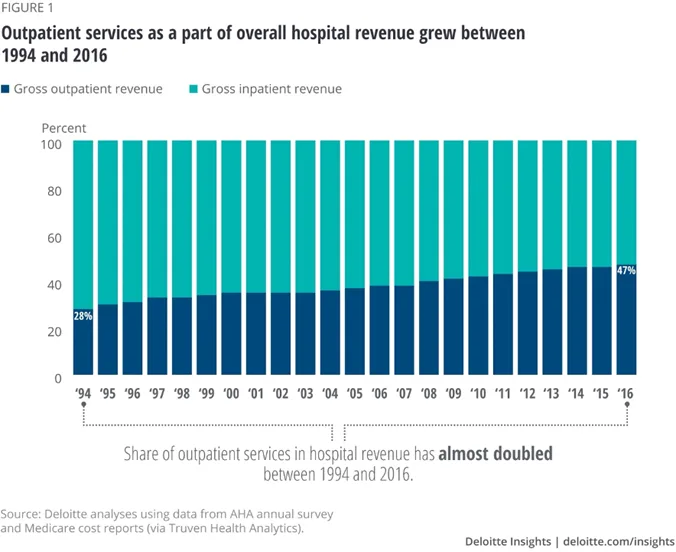
Data published in Deloitte's report, referring to the United States market, show that inpatient hospital revenues are already migrating at high intensity from the inpatient setting to ambulatory units. As shown in the chart below, the figure nearly doubled from 1994 to 2016.
In Brazil, we are still taking the first steps in developing new units and multidisciplinary teams dedicated to ambulatory surgery. There is a need for a broader understanding of the subject, beyond the notion of something limited, simple, or rudimentary. As we saw earlier, ambulatory surgery is an important tool for increasing the operational capacity of operating rooms and inpatient beds in general hospitals, expanding the supply of this type of care, with a focus on the 20% of cases that necessarily need to be performed in a general hospital unit. Often, this occurs due to factors such as the high complexity of the procedure, combined with the patient's specific health conditions, generally with several comorbidities, which do not allow their treatment to be carried out in an ambulatory setting.
The advantages of ambulatory surgery units for public and private healthcare systems are clear. When we consider the possibility of reducing waiting lines and providing faster care for critical health conditions in general hospitals, made possible by the existence of ambulatory surgical units with a better cost ratio, we observe that these units can play a fundamental role in balancing the supply of and demand for surgical procedures in Brazil, working as a relief valve for up to 80% of elective procedures and freeing up space for a greater number of specific cases in general hospitals. Along the same lines, ambulatory units can also contribute significantly to reducing the waiting lines and backlog of cases built up in recent years as a result of the COVID-19 pandemic.
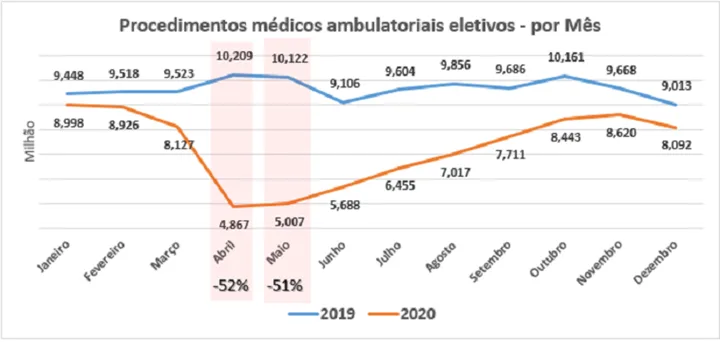
During this period, according to the CFM (Conselho Federal de Medicina), the restrictions on access to general hospitals, the measures to ration beds in these hospitals for the treatment of COVID-19 cases, and patients' fear of seeking out general hospital units caused a drop of 27 million exams, surgeries, and other elective procedures in the SUS.
The conventional structure of an ambulatory surgery unit is focused on serving a wide range of elective cases and does not include, within its scope of care, wards and beds dedicated to treating patients with contagious infections, including COVID-19. In countries where units of this type are available on a larger scale, the impact on elective procedures was smaller, since the high occupancy of general hospital beds culminated in the interruption of elective cases in these hospitals; moreover, because they were treatment centers for COVID-19 patients, many patients who needed elective care for other health conditions avoided visits to general hospitals as much as possible, further aggravating the situation.
With a significantly lower risk of admitting COVID-19 patients and the absence of wards for treating this type of patient (who were cared for in conventional hospital units, such as a general hospital), ambulatory surgical units proved to be great allies of local healthcare systems in partially mitigating this problem.
The expansion of ambulatory surgery in Brazil will benefit from the need for a model that offers more competitive costs, safety, and a better overall experience for the patient, optimized clinical outcomes, and reduced investment in setting up new units. As technology and medicine advance, more and more procedures will be able to be performed in ambulatory units, which will also contribute greatly to the migration of a large part of the surgical volume to this type of care structure.
Those who are best prepared to seize the opportunities available in the field of ambulatory surgery, and to ride the wave of this irreversible path in Brazil, will come out ahead.
Fabricio Galvão is a founding member and market director of the Sociedade Brasileira de Cirurgia Ambulatorial (SOBRACAM), the Brazilian delegate to the International Association for Ambulatory Surgery (IAAS), an entrepreneur, and an investor in the healthcare sector.
References
- Quadros, N., et al. Hospital Dia – Um Modelo Sustentável – Ed. Dulcina, 2013.
- SOBRACAM – Sociedade Brasileira de Cirurgia Ambulatorial – https://www.sobracam.com.br – accessed on June 10, 2022.
- Newitt, P. "4 ASC growth opportunities, according to a Surgical Care Affiliates executive" – Becker's ASC Review, February 2nd, 2022: https://www.beckersasc.com/leadership/4-asc-growth-opportunities-according-to-a-surgical-care-affiliates-exec.html
- Figure 1: Deloitte Insights
- Figure 2: CFM
Fabrício Galvão